
Areas Worth Visiting
Each neighborhood has its own character
Old Quarter
3/5ModerateGuide to Nha Trang's Old Quarter (Hung Vuong, Biet Thu, Nguyen Thien Thuat) covering backpacker bars, expat dives, prices, safety tips, and what to expect.
10 nightlife spots listed
Tran Phu Beach
3/5ModerateGuide to Tran Phu Beach in Nha Trang covering rooftop bars, beach clubs, nightclub prices, safety tips, and what to expect along the city's coastal strip.
10 nightlife spots listed
Vinpearl Island
4/5SafeGuide to Vinpearl Island (Hon Tre) in Nha Trang Bay covering resort bars, Vinpearl Harbour entertainment, prices in VND, access via cable car, and what to expect.
10 nightlife spots listed
District Map of Nha Trang
Pick a district to recenter the map and see hotels nearby.
Where to stay in Nha Trang
Compare hotels and rentals across the city's nightlife districts.
See places to stay and current pricesNha Trang sits on a long curve of beach along Vietnam's south-central coast, a former fishing port that became the country's primary beach resort city before Da Nang caught up. The nightlife here is shaped by three things that don't exist in the same combination anywhere else in Vietnam: a 6-kilometer beachfront strip with hotel rooftops stacked behind it, a backpacker quarter dense with bars two blocks inland, and a steady flow of Russian and Chinese tourists that has reshaped the venue mix over the past decade.
Overview
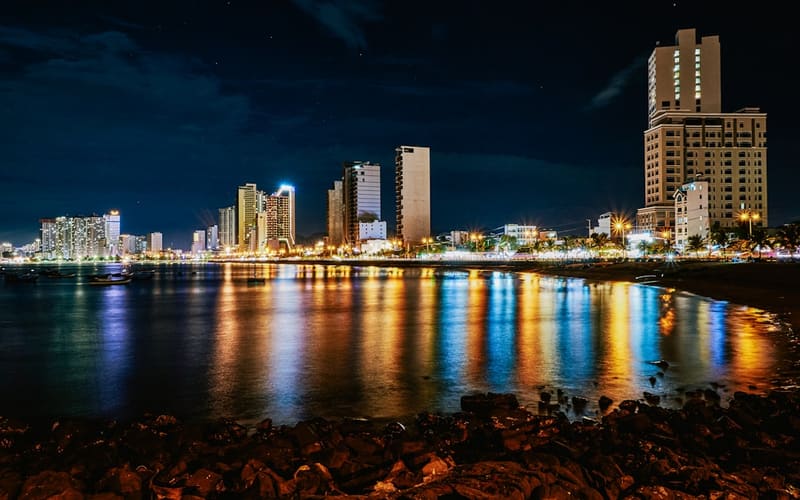
Tran Phu Street is the spine of the city. The road runs the length of the beach, with the sea on one side and a continuous wall of hotels, resorts, and beach clubs on the other. The cluster of rooftop bars (Skylight, Altitude, Vue at the Havana, the Yasaka rooftop) sits on top of these hotels. The beachfront clubs (Sailing Club, Louisiane Brewhouse) sit at ground level, with direct sand access.
Two blocks inland from Tran Phu, the grid bordered by Hung Vuong to the north, Tran Quang Khai to the south, Biet Thu running east-west, and Nguyen Thien Thuat running north-south forms the backpacker quarter. This is where most of the budget bars, hostels, dive shops, and Western restaurants are concentrated. Locals sometimes call it the "European Quarter" or "Foreigners Street." Russian signage is as common here as Vietnamese.
The third zone is Hon Tre Island, a 30-minute boat ride or 10-minute cable car trip across Nha Trang Bay. The island holds the Vinpearl resort complex, with its own bar and entertainment infrastructure aimed at hotel guests rather than the broader public. Vinpearl Harbour's "Little Bui Vien" zone tries to recreate a streetside bar district inside a controlled resort environment.
Nha Trang's nightlife is smaller and more concentrated than Saigon's, louder and more party-focused than Da Nang's, and more international than any other coastal Vietnamese city. The city has cleaned up some of the rougher edges that earned it a reputation in the 2010s, but the core scene remains beach bars by day, rooftop clubs by night, and backpacker dives until close.
Legal Context
Vietnam's national laws prohibit prostitution. The criminal code classifies it as a "social evil," and the government runs periodic enforcement campaigns alongside crackdowns on drugs and illegal gambling. Penalties include administrative fines and detention, with harsher sentences for those organizing the trade. Foreign clients caught in raids typically face deportation rather than prosecution, but passports can be confiscated for the duration of an investigation.
Nha Trang's enforcement is moderate. Khanh Hoa provincial police conduct periodic sweeps of massage parlors and karaoke venues suspected of facilitating paid services, with attention spiking before major holidays and during international events. Russian and Chinese tourist arrivals draw additional law enforcement focus on venues catering specifically to those markets.
The standard beach bars along Tran Phu, the rooftop clubs, and the open-fronted backpacker bars on Biet Thu are licensed entertainment businesses focused on drinks and music. They are not pickup spots in any meaningful sense. KTV venues and some massage shops operate in a separate space, with discreet back-room activity behind a legitimate entertainment license. These places are easy to identify by their location (often standalone buildings with parking lots), minimal English signage, and a clientele dominated by Korean, Chinese, and Vietnamese male groups.
Key Areas
Three zones cover most of Nha Trang's adult nightlife. They sit within a 10-minute taxi ride of each other and attract different crowds.
Tran Phu Beach
Tran Phu Street is the beachfront strip, running north to south along the 6-kilometer coast. The major rooftop bars (Skylight at the Premier Havana, Altitude at the Sheraton, Vue at the Havana Hotel) sit on top of mid-rise to high-rise hotels lining the street. Beach-level venues like Sailing Club and Louisiane Brewhouse open directly onto the sand. The crowd here is older, better-dressed, and more international than in the backpacker quarter inland. Cocktail prices reflect that.
Old Quarter
The Old Quarter is the local nickname for the backpacker grid two blocks inland from Tran Phu. The main streets are Hung Vuong, Biet Thu, Tran Quang Khai, and Nguyen Thien Thuat. This is where Booze Cruise, Why Not Bar, Red Apple Club, Crazy Kim Bar, and dozens of smaller dive bars and pubs operate. The crowd is younger, drunker, and more focused on cheap drinks and meeting other travelers. Russian and Eastern European visitors are particularly visible here. The grid is highly walkable, with bars sitting next to hostels next to massage shops next to Vietnamese street food stalls.
Vinpearl Island
Hon Tre Island, also called Vinpearl Island, sits across Nha Trang Bay from the city. Access is by the world's longest sea-crossing cable car or by boat. The Vinpearl resort group operates the entire entertainment infrastructure on the island: resort bars at Vinpearl Luxury, Vinpearl Resort, and Vinpearl Beachfront; the Vinpearl Harbour entertainment zone with its own bar street called "Little Bui Vien"; and the Wave Bar overlooking Nha Trang Bay. The atmosphere is upscale, family-friendly, and contained within the resort ecosystem. Last cable car back to the mainland runs around 9 PM, so independent travelers usually need to plan an overnight stay or take a private boat back.
Safety
Nha Trang sits in the middle of the Vietnamese coastal safety range. It's safer than the seedier corners of central Saigon and less polished than Da Nang or Hoi An. Khanh Hoa provincial authorities have invested in surveillance cameras along Tran Phu, and the visible police presence in the tourist core is heavier than what you'll see in most Vietnamese cities.
Motorbike phone snatching is the most reported incident type. Thieves on scooters target tourists walking with phones in their hands, particularly on side streets connecting the backpacker quarter to Tran Phu, and on the smaller lanes around the night market. Keep your phone in a zipped pocket while walking near roads.
Drink overcharging happens at the rougher bars in the Old Quarter. Some venues quote one price when you order and present another on the bill, or add "service charges" and "ice charges" that weren't disclosed. Confirm prices when ordering, count your drinks as you go, and review every bill before paying.
Drink spiking has been reported repeatedly at venues frequented by male tourists drinking alone. The pattern follows the standard playbook: a friendly local woman approaches, drinks appear, the tourist wakes up in a hostel or hotel with valuables missing. Stick to bottled drinks you've watched being opened, and don't leave glasses unattended.
Pedestrian traffic on Tran Phu is the underrated danger. The street carries fast-moving cars, motorbikes, and tourist buses. Cross slowly, predictably, and don't stop in the middle of the road. The pedestrian crossings near the major beach access points have traffic lights that vehicles generally respect.
Beach safety is its own category. Rip currents along Tran Phu Beach are strong from October through January, with multiple drownings reported each season. Red and yellow flag warnings are posted but not always heeded. Don't swim drunk and don't swim after dark.
Cultural Norms
Nha Trang's character is south-central Vietnamese: friendlier than the north, more reserved than Saigon, and shaped by decades of catering to international visitors. Locals are welcoming but practical. The city has spent forty years building an economy around tourism, and most direct interactions you'll have on the beach or in the bars are commercial in nature.
The dress code in central Nha Trang is relaxed. Shorts and tank tops are fine on Tran Phu, in the Old Quarter, and at beach bars. The rooftop clubs lean toward smart-casual after 8 PM, with some venues turning away flip-flops and gym shorts at the door. When venturing outside the tourist core, particularly to temples or the local seafood neighborhoods north of the river, cover shoulders and wear longer pants.
Drinking culture follows Vietnamese norms. Beer is the dominant social drink, consumed over ice in plastic cups at street-level spots and from chilled bottles in bars. The standard local toast is "mot, hai, ba, vo" (one, two, three, cheers) with the whole table drinking together. Refusing to drink is acceptable but should be explained politely. Citing a medical condition or driving is the most accepted excuse.
Karaoke (KTV) plays a different role here than in Western nightlife. Vietnamese KTV ranges from family singing rooms to adults-only venues with hostess service. The two are easy to distinguish: family KTVs have Vietnamese signage and families coming and going, while the hostess venues are more discreet, often in standalone buildings with valet parking and minimal English signage. The latter cater mainly to Korean and Chinese business clients.
Russian influence in Nha Trang is unmistakable. Russian-language signage covers shop fronts along Biet Thu and Hung Vuong. Russian-speaking staff work at the bigger hotels and many bars. The Russian tourist demographic skews family and couples in recent years, with the single male party crowd of the 2010s largely gone. The Chinese tourist market replaced much of that volume, but with a different drinking and venue pattern (KTV, dinner cruises, hot pot restaurants rather than beach bars).
Social Scene
The expat community in Nha Trang is small compared to Da Nang or Saigon, centered on a handful of dive instructors, English teachers, and digital nomads. The crowd cycles seasonally with the dive season and tourism flows. Russian long-term residents form their own community around the Russian Cultural Center and Russian-language schools, generally not overlapping with the English-speaking expat scene.
Booze Cruise Sports Bar on Nguyen Thien Thuat is the most reliable meeting point for English-speaking foreigners, with live football coverage, Western food, and regular promotions. Crazy Kim Bar on Biet Thu draws a similar crowd. Louisiane Brewhouse on Tran Phu attracts a more mixed daytime crowd, including expats from Cam Ranh's growing business community.
Dive shops are a significant social anchor. Sailing Club Divers, Rainbow Divers, and several smaller operators run daily boat trips that double as low-key social events. Many travelers extend their stay after meeting people on dive trips.
Couchsurfing meetups happen sporadically. Facebook groups (search "Nha Trang expats" and "Nha Trang dive community") organize occasional get-togethers, language exchanges, and weekend beach hangouts.
Dating Apps
Tinder is the dominant app in Nha Trang as in the rest of Vietnam. The user base is smaller than in Saigon or Da Nang, which means matches come more slowly. Vietnamese women on Tinder in Nha Trang are typically working in tourism, hospitality, or as university students from the local Nha Trang Institute or Khanh Hoa University. English skills vary widely. Many profiles are Russian, Korean, or Chinese tourists on short trips.
Bumble has a much smaller pool, drawing mostly expats, foreign teachers, and Vietnamese women working in international tourism.
Badoo has historically been more active in Nha Trang than in most Vietnamese cities, partly because of the Russian and Eastern European user base.
VietnamCupid (now Vietnam Social) attracts an older user base, both Vietnamese and expat. The platform leans toward more serious dating intentions. Some users are looking for sponsorship or financial arrangements rather than dating in the Western sense. Read profiles carefully.
Practical notes: response rates drop sharply for cold messages. Matches you've had a back-and-forth with tend to be reliable. Nha Trang is small enough that you'll often run into matches on Tran Phu or in the Old Quarter. The dating pace is similar to Da Nang, with multiple coffee or drink dates before anything physical.
Scam Warnings
Bar bill padding is the most reported scam in the Old Quarter. A bar advertises drinks at one price, then presents a bill that includes "service charges," "tax," inflated prices, or items you didn't order. Some venues quote prices verbally that turn out to be higher in writing. Why Not Bar in particular has multiple online reports of staff short-changing customers by 100,000 VND or more on cash transactions. Confirm prices when ordering, count your drinks, and review every bill carefully. Pay in stages rather than running a long tab.
Massage parlor upselling follows the same pattern as in other Vietnamese cities. The advertised price covers a basic massage, then staff pressure for upgrades, extras, and tips that double or triple the cost. Agree on the total price and scope of service before anything starts, and leave if pressure begins.
Taxi meter manipulation happens at the airport, train station, and outside the bigger hotels. Some drivers use altered meters or refuse to use the meter, quoting fixed inflated rates. Stick to Xanh SM (green electric), Mai Linh (green), Vinasun (white), or use the Grab app. Airport to Tran Phu Beach should run 250,000 to 380,000 VND ($10-15) by metered taxi.
Fake friendship cons occur at the rougher bars, where a Vietnamese or Russian-speaking woman initiates conversation, suggests moving to a "better bar" or KTV nearby, and the bill arrives at staggering prices. The new friend then vanishes or pressures you to pay. Don't follow strangers to unfamiliar venues.
Hotel booking fraud is a documented problem in Khanh Hoa province. Fake hotel social media pages impersonate real resorts and request bank transfer deposits at suspiciously low rates. Book only through verified channels (the hotel's official website, Booking.com, Agoda) and never wire deposits to personal accounts.
Best Times
- February through August (dry season): Best weather, calm seas, full beach bar operations. April through June is peak heat and humidity. Late February to early May is the sweet spot.
- September through January (wet season): Heavy rain, rough seas, periodic storms in October and November. Beach bars scale back. Indoor venues remain open. Beach swimming is dangerous from late October through December.
- April 30 to May 2 (Liberation Day): Domestic tourism spike, hotels book out, prices climb.
- Mid-June through August (Vietnamese summer holiday): Peak domestic season. Skylight and the major rooftops sell out their best tables. Hotel prices climb sharply.
- Tet (late January or early February): Many bars and venues close for a week. The city goes quiet during the Vietnamese New Year period.
- Friday and Saturday, 9 PM to 1 AM: Peak nightlife hours across all three zones.
Getting Around
Grab is the default for everything in Nha Trang. The app works for both car and motorbike rides (Grab Bike), with consistent pricing and English support. A typical car ride within central Nha Trang runs 30,000 to 80,000 VND ($1.20-3.20). Grab Bike is cheaper, roughly half the car price, and faster in traffic.
Xanh SM (green electric cars) is the newest option, often cheaper than Grab for short rides and increasingly common.
Traditional taxis (Mai Linh in green, Vinasun in white) are reliable. Pricing is metered. Always make sure the meter runs from zero at pickup. Some drivers offer a fixed inflated price; decline and insist on the meter.
Cyclos (bicycle rickshaws) operate along Tran Phu and around the night market. They're slow, more expensive than Grab for similar distances, and primarily aimed at tourists. Negotiate the price in writing before boarding.
Scooter rental costs 120,000 to 200,000 VND ($5-8) per day from hostels, hotels, and dedicated rental shops in the Old Quarter. An international driving permit is technically required. Police checkpoints stop foreign riders for documentation checks, particularly along Tran Phu and on the road to the Po Nagar towers. Helmets are mandatory. Don't ride drunk.
The Vinpearl cable car from Cau Da Port crosses to Hon Tre Island. Operating hours are roughly 9 AM to 9 PM. Round-trip fare for non-resort guests is 800,000 VND ($32) and includes VinWonders park entry.
Walking works within zones. The Old Quarter is highly walkable. Tran Phu Beach is a long walking strip if you have time. Cross between the two on signal-controlled crossings or use a Grab bike.
What Not to Do
- Do not drive a scooter after drinking. Vietnamese DUI enforcement has tightened sharply, with breathalyzer checkpoints common after 9 PM
- Do not engage with anyone offering drugs. Vietnam carries the death penalty for trafficking, and penalties for possession include long prison terms
- Do not swim drunk or after dark, particularly during October through January when rip currents are strongest
- Do not photograph police, military personnel, or government buildings
- Do not assume KTV venues are standard nightclubs. Many include hostess services with separate bill structures
- Do not leave drinks unattended, especially at the rougher Old Quarter bars
- Do not carry your full passport at night. A photocopy is sufficient for ID purposes
- Do not pay a bar bill without checking each line item
- Do not transfer hotel deposits to personal bank accounts. Fake booking fraud is rampant in Khanh Hoa
- Do not wander into dark side streets while looking at your phone. Motorbike snatching targets distracted tourists
- Do not assume English is widely spoken outside the Old Quarter and major rooftop bars. Russian is more useful in many bars
- Do not visit during the wet season expecting good beach weather. October and November bring genuine storms
Get the Legal Status PDF, 50 countries
Newsletter signup coming soon. Check back shortly.
Flights to Nha Trang
Compare prices across airlines. Filter by stops, time, and cabin.
Airport transfer to Nha Trang
Pre-booked transfers cost about the same as a metered taxi but cut out the airport queue, the meter argument, and the "no English" routine that takes some drivers to the wrong address. Fixed price quoted before booking, driver tracks your flight, waits with a name sign at arrivals.
Book a KiwiTaxi transferRelated Guides
Old Quarter
Guide to Nha Trang's Old Quarter (Hung Vuong, Biet Thu, Nguyen Thien Thuat) covering backpacker bars, expat dives, prices, safety tips, and what to expect.
Read guideTran Phu Beach
Guide to Tran Phu Beach in Nha Trang covering rooftop bars, beach clubs, nightclub prices, safety tips, and what to expect along the city's coastal strip.
Read guideVinpearl Island
Guide to Vinpearl Island (Hon Tre) in Nha Trang Bay covering resort bars, Vinpearl Harbour entertainment, prices in VND, access via cable car, and what to expect.
Read guideFrequently Asked Questions
Was this guide helpful?