Solo safety
Comfortable
Monthly budget
USD 1,200-2,200 per month for a comfortable mid-tier life including a one-bedroom apartment, daily street food and one nicer meal out, gym, and a weekend trip.
English level
Patchy English
Visa-free for US
Yes
Nomad-friendly
Yes
Best season
November to February
Legal status
illegal tolerated
Country
Thailand
Safety realism: scams to know before you go
The specific patterns operators run on solo male travelers in Bangkok. These are not generic warnings; they are the schemes that actually get reported. Knowing the pattern is most of the defence.
Grand Palace closed scam
A friendly-seeming local near the Grand Palace tells you the temple is closed for a Buddhist ceremony and offers a tuk-tuk tour to alternative temples for 'just 20 baht'. The driver takes you to a gem shop, a tailor, and a souvenir factory where commissions get paid on whatever you buy. The Grand Palace was never closed.
How to avoid
Walk straight to the official ticket counter. The Grand Palace operates 8:30 to 15:30 daily, almost never closed. Ignore anyone who approaches you with information about temples or tours within 200 meters of the gate.
Tuk-tuk gem scam
Variant of the temple scam where the driver convinces you to visit a 'tax-free' or 'government-sponsored' gem warehouse. You're shown export documents, told the stones are an investment that will triple in value back home. The 'sapphires' are coloured glass, the documents are fake.
How to avoid
Thailand has no tax-free or government-sponsored gem sales for tourists. If a driver mentions gems, walk away. The same scam runs in Pattaya and Chiang Mai. Don't argue, just exit and find another vehicle.
Airport taxi meter refusal
At Suvarnabhumi or Don Mueang, drivers offer to skip the metered taxi queue with a flat 800 to 1,500 THB price to central Bangkok. A real metered taxi to Sukhumvit runs 250 to 400 THB plus tolls.
How to avoid
At Suvarnabhumi, go down to floor 1 and join the official taxi queue. Insist on the meter ('by meter, please'). If the driver refuses, take his cab number, get out, and join the next one. Or use Grab from the official Grab pickup at floor 1, exits 4 and 7.
Khao San bar tab inflation
Backpacker bars on Khao San and Soi Rambuttri sometimes add unordered drinks or shots to the tab. Groups distracted by music or in a circle of new friends don't notice until they're handed a 4,000 THB receipt for what felt like a 1,500 THB night.
How to avoid
Pay round by round at the bar, not on a tab. Photograph the menu price list when you sit down. If the tab is wrong, ask for an itemised printout and dispute item by item before paying.
Patpong 'show' upstairs cover charge
Touts on Patpong Soi 2 hand out leaflets advertising a free ping-pong show upstairs. You're walked into a venue, served one beer, then handed a 4,000 to 8,000 THB bill 'for the show'. Two doormen block the exit until you pay.
How to avoid
Never follow a leaflet-handing tout up any staircase in Patpong. If you ignored that advice, leave the moment a beer is poured before you've seen a price list. Push through if blocked; the venue almost never escalates physically because police would inspect.
Where to live as a solo traveler
The neighborhoods that consistently work for solo arrivals, with realistic monthly rent for a furnished one-bedroom. Choose by stay length: most first-month visitors do well in the expat-default; long-stayers tend to migrate to the local-priced alternatives.
Sukhumvit (Asoke, Phrom Phong, Thong Lo)
RecommendedThe default expat strip. Wide pavements (rare for Bangkok), the BTS Skytrain running the whole length, every restaurant cuisine on Earth, gyms on every other block. Asoke is busy and central; Phrom Phong is quieter with the EmQuartier mall; Thong Lo is the upscale nightlife-and-cafe scene. Less authentically Thai but easiest for a first month.
Monthly rent
USD 550-1,100 for a furnished one-bedroom in a 2010+ building with pool and gym
Ari
RecommendedThe quieter sister to Thonglo, ten minutes north on BTS. Third-wave cafes, independent restaurants, almost no nightlife. Mix of long-stay expats, Thai professionals, and digital nomads working from cafes. Very walkable inside Soi Ari 1-4. Drops the noise level by a lot.
Monthly rent
USD 450-850 for a furnished one-bedroom in a mid-range condo
Phra Khanong / On Nut
RecommendedWhere the long-term expats who outgrew Sukhumvit move. Newer condos at half the price of Phrom Phong, the BTS still works, a Habito mall and W District cover daily needs. More local than tourist, less manicured than Ari. The trade-off is a 25 minute commute to anywhere central.
Monthly rent
USD 350-650 for a furnished one-bedroom
Riverside (Sathorn / Charoenkrung)
The atmospheric option. Old Bangkok along the Chao Phraya with art galleries, river-view bars, and the new ICONSIAM mall. Quiet at night, beautiful river commutes by ferry, but disconnected from the BTS in places (the new MRT Blue Line extension helps). Best for writers, photographers, and anyone who works from home.
Monthly rent
USD 500-1,200 depending on river view
Where to stay in Bangkok on a longer trip
Compare apartments and aparthotels around the neighborhoods above. Longer stays (14+ nights) typically get monthly-discount pricing not visible on standard hotel sites.
See places to stay and current pricesWhy Bangkok Works for a Solo Male Traveler
Bangkok is the easy answer to "where do I go for three months in Asia". The infrastructure is built for long-stay foreigners in a way few cities in the world match. You can land at Suvarnabhumi at 11pm, take a metered taxi to a furnished serviced apartment in Phrom Phong, and be working from a cafe with gigabit fibre by 9am the next day. Visas are forgiving, the language barrier shrinks fast in the central districts, and 75,000 THB a month buys a life that would cost three times as much in any comparable Western city.
The day-to-day fits a 25 to 40 year old man planning a long stay particularly well. Mornings: a real coffee at a third-wave roaster for 130 THB, a Muay Thai class or weight session at a 2,500 THB-per-month gym, a hot shower without electricity anxieties. Afternoons: head-down work from a coworking space or a cafe with free fast wifi. Evenings: 80 THB pad krapow from the cart on your soi, then a 350 THB craft beer at a rooftop bar in Thonglo if you want to socialise, or a 60 THB plate of mango sticky rice and an early night if you don't. None of this is performative. Most expats and nomads here live exactly this rhythm.
The city suits the slow traveller better than the weekender. If you have less than two weeks the obvious sights (Grand Palace, Wat Pho, Chatuchak) start to feel transactional and the heat and traffic grind you down. Three months in is when Bangkok stops being a place you visit and becomes a place you live. By month two you have a regular gym, a barista who knows your order, a Muay Thai trainer who teaches you the proper way to throw a teep, and you can navigate the BTS-MRT-Grab-motorbike taxi mesh without thinking.
Quick Practical Numbers
A one-bedroom condo in a 2010s or newer building with pool and gym runs 15,000 to 28,000 THB monthly in the expat-popular areas (Phrom Phong, Thonglo, Ari, On Nut). Older buildings and farther-out neighbourhoods drop that to 9,000 to 14,000 THB but you give up the BTS proximity. Most expats sign a one-year lease for the lowest rate, or pay a 20 to 30 percent premium for month-to-month through agents like Hipflat or Renthub.
A standard street-food meal is 60 to 90 THB. A meal at a sit-down Thai restaurant where the menu has English: 180 to 320 THB. A craft cocktail at a Thonglo rooftop: 350 to 500 THB. A real-deal espresso bar coffee: 110 to 150 THB. A Grab ride across central Bangkok: 130 to 250 THB. A BTS ride from Asoke to Mo Chit: 47 THB.
For a solo nomad working from cafes, you're spending 50,000 to 65,000 THB monthly on a reasonable mid-tier life. Couples or anyone wanting a serviced apartment with daily housekeeping push to 80,000+ THB. Budget travellers in shared dorms eating exclusively street food survive comfortably on 25,000 to 35,000 THB.
Visa Reality
US passport holders get 60 days visa-exempt at arrival (the policy doubled from 30 days in 2024). You can extend once at any Immigration office for 1,900 THB, which buys 30 more days. After 90 total days, you do a border run.
For longer stays, the DTV (Destination Thailand Visa) launched in mid-2024 has become the obvious choice for nomads. It's a five-year multi-entry visa with each entry good for 180 days. Application fee is 10,000 THB, you need to show 500,000 THB in a bank account or proof of remote employment, and you can apply at any Thai consulate abroad. It avoids the constant visa-run hassle of the old system.
If you actually want to root for years, the Long-Term Resident (LTR) visa launched in 2022 for highly skilled workers and high-net-worth applicants. Five years renewable, tax breaks on overseas income, dedicated immigration lanes at airports. Income threshold is the catch (USD 80K minimum, more for higher tiers).
Getting Around: BTS, MRT, Grab, Motorbike Taxi
Bangkok traffic is generational. From 4pm to 7pm on a Friday in Sukhumvit, a 4 km cab ride takes 90 minutes. You will plan your life around this.
The BTS Skytrain and MRT subway between them cover most places you actually need to go for daily life. The BTS runs from Bang Wa in the south to Khu Khot in the north, with the central interchange at Siam. Fares are 17 to 62 THB per ride. The MRT Blue Line is a complementary loop. Together they hit Sukhumvit, Silom, Chatuchak, Rama IX, the riverside, the airport (via the Airport Rail Link), and the western suburbs. If your apartment is within walking distance of any BTS or MRT station, that's the single most important practical decision you make.
For everything off the rail lines: Grab (Southeast Asia's Uber) is reliable and cheap. A typical ride across central Bangkok runs 130 to 250 THB. The app does in-app payment, so no haggling. Drivers' English is patchy; share the destination map pin, not a typed address.
Motorbike taxis (the orange-vest "win" drivers waiting at every soi entrance) are the secret weapon for short hops in heavy traffic. 1 to 3 km will cost 30 to 80 THB and they will weave through stopped cars in ways that feel illegal but aren't. Pull on the helmet they offer (mandatory, enforced), agree the price by pointing or saying the destination, and hold on. Not for nervous riders.
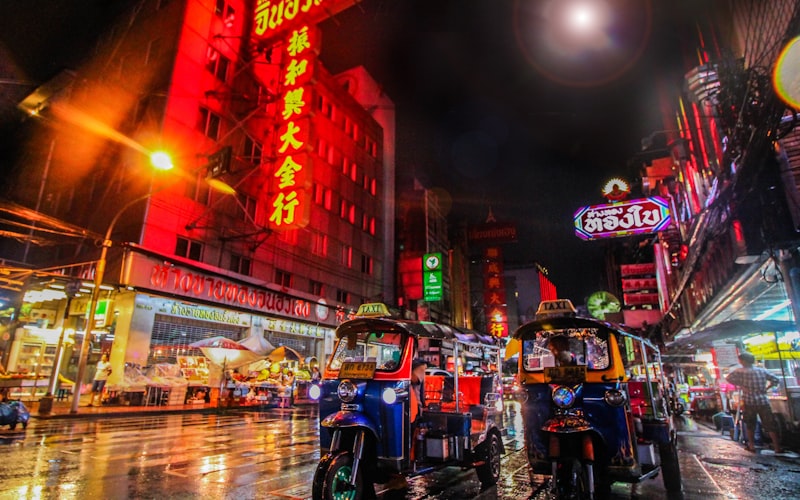
Tuk-tuks are tourist props now. Negotiate hard if you want one for the experience; in central Bangkok they will quote 200 THB for what Grab does for 90.
Where to Meet People (Without the Bar Scene)
This is where Bangkok shines for solo travellers who don't want to spend every night drinking. The community infrastructure for adult men with money and time is dense.
Coworking spaces are the biggest social on-ramp. The Hive (Thonglo and Sathorn), JustCo (multiple locations), and WeWork (Asoke and One Bangkok) all run weekly member events, ranging from coffee mornings to talks to monthly rooftop drinks. Day passes are 350 to 550 THB; monthly memberships start around 5,500 THB. Within two weeks of working from any of these you'll have a half-dozen regular faces.
Muay Thai gyms are the second on-ramp, and for men in this demographic specifically, often the best one. Sityodtong, Kaewsamrit, Master Toddy's, and FA Group all run two-hour group classes twice daily for 350 to 500 THB per session, or monthly memberships at 5,000 to 9,000 THB unlimited. The training partners turn into the friend group; the same faces appear class after class. Most foreign students arrive solo and stay weeks to months.
Language exchanges and Thai classes (Duke Language School, Pro Language) bring the local-meets-foreign crowd together for genuine mixing. Run clubs (Bangkok Runners on Lumpini Tuesday evenings, Sukhumvit Striders Saturday mornings at Benjasiri Park) draw a mixed expat-Thai pack. Football leagues for men 30+ play out of stadiums in On Nut and Bang Na. Climbing gyms (Rock Domain, The Hive Climbing) have an active expat scene.
For long-stay food and drink: Bambini in Ari is the Sunday morning regulars' cafe, Wallflowers in Charoenkrung for natural wine and conversation that's actually conversational, Iwane in Phrom Phong for Japanese coffee culture. None of these involve a velvet rope or a cover charge. None pretend to be what they're not.
Cost of Living Breakdown
Specific monthly numbers for a typical solo male nomad in Bangkok, in THB and approximate USD at 36 to the dollar:
- Rent (1BR condo, Phrom Phong or Ari, modern building, pool/gym): 18,000-24,000 THB (USD 500-670)
- Utilities (electric heaviest in summer, water, internet, building fees): 1,800-3,500 THB (USD 50-100)
- Food (mix of street, mid-tier, one nice dinner a week): 13,000-17,000 THB (USD 360-475)
- Coffee at third-wave cafes daily: 3,500-5,000 THB (USD 100-140)
- Gym (real, with weights): 1,500-3,500 THB (USD 40-100)
- Muay Thai (drop-in 3x/week): 4,500-6,000 THB (USD 125-170)
- Transport (BTS, MRT, Grab combined): 3,500-5,500 THB (USD 100-155)
- Going out (cocktails, restaurants, weekend events): 6,000-12,000 THB (USD 165-335)
- Phone (Thai SIM with data): 350-550 THB (USD 10-15)
- Coworking membership: 5,500-9,500 THB (USD 155-265)
Total monthly: 57,500-86,500 THB, or roughly USD 1,600-2,400. A budget-conscious solo can compress that to USD 1,000-1,300 by cooking more, dropping the coworking, and skipping the rooftop bars. Anyone wanting a fancy serviced apartment, weekly massage, and frequent restaurants will push past USD 3,000.
Logistics: SIM, Money, Apps You'll Actually Use
For mobile data, install an eSIM before you fly. Thailand has full eSIM support across the major carriers (AIS, TrueMove H, dtac) and the airport SIM kiosks add a 30 to 50 percent markup. Yesim and similar services cover Thailand with pay-as-you-go plans that activate the moment you land.
For money: Open a Wise account before leaving home. The Wise debit card works at every Thai ATM with no foreign transaction fee (Thai ATMs charge a 220 THB foreign withdrawal fee per transaction, so withdraw in larger amounts less often). Revolut also works. Bangkok Bank, Kasikorn, and SCB will open accounts for foreigners on a long-stay visa, requires a work permit or a 3-month visa as proof of intent for the easier banks. Helpful for paying rent and recurring local bills.
Essential apps: Grab (taxis, food delivery, groceries), LINE (every Thai uses it, you need it), Google Maps (transit directions work well for BTS/MRT), Foodpanda (alternative to Grab for delivery), DTV/Immigration Bureau app for visa extensions.
Where to Meet People Continued and Day Trips
Bangkok pairs well with weekends out of the city.
Hua Hin (3-hour drive, 4-hour minivan from Victory Monument): the beach town the Thai royal family vacations in. Calmer than Pattaya, decent surf at Cha-Am beach, weekly artist night market. A Friday-to-Sunday minivan-and-Airbnb trip lands around 4,500 THB all-in.
Khao Yai (2.5 hours northeast): national park with wild elephants, working vineyards (PB Valley, GranMonte), boutique resort scene. Best weekend trip if you want forests and mountains, ages 28+ profile, lots of solo and couple travellers. Hire a car, 4,500 to 8,000 THB for the weekend.
Kanchanaburi (2 hours west): the River Kwai, Erawan Falls (seven-tier waterfall, swim in each pool), Hellfire Pass WWII memorial. Sleep on a floating bamboo raft on the river. A more historical, less polished weekend.
Ayutthaya (90 minutes north by train, 60 by car): the old Siamese capital. Bicycle-rentable ruins, no nightlife to speak of, a daytrip rather than overnight. Best in cooler months.
Bottom Line
Bangkok suits the solo male traveller looking for infrastructure, affordable comfort, and a real social on-ramp. It doesn't suit travellers who need to feel they've "discovered" a place; the expat pathways are well-worn. It also doesn't suit anyone allergic to heat, traffic, or pollution; April and the burning-season smoke are real costs.
For first-month visitors, base in Sukhumvit (Asoke or Phrom Phong) for the infrastructure shock absorber, then move to Ari or Phra Khanong when you understand the city. Get a gym, join a coworking space, take a Thai class, find a Muay Thai gym. Within four weeks the city stops being foreign.
For the explicit nightlife side of Bangkok the main TDG site covers it city by city; see the Bangkok page and the Thailand country guide. This page is the lifestyle frame; that one is the after-dark one.
Staying connected in Thailand
Tourist SIM cards usually require your passport and a trip to a kiosk. An eSIM works the moment you land: scan a QR, pick a data plan, done. Roaming charges from your home carrier rarely make sense for trips longer than a few days.
Yesim covers 200+ countries including Thailand with pay-as-you-go data and duration-based plans, useful when trip length is unpredictable. Works on iPhone XS and newer, plus most Android phones from 2020 onward. No contract, no commitment.
Get Yesim eSIMNeed the after-dark context too?
This solo travel guide deliberately stays on the lifestyle side of Bangkok. For the full legal framework, adult entertainment districts, and venue-level coverage, see the main TDG Bangkok city page and Thailand country guide.
Frequently Asked Questions
Affiliate disclosure. Some links on this page lead to Stay22, Yesim, and other partners. If you book through them we may earn a small commission at no extra cost to you. We only link to operators we'd use ourselves; no editorial decision on this page is influenced by commissions.