Entertainment Districts
Pick a neighborhood to start exploring
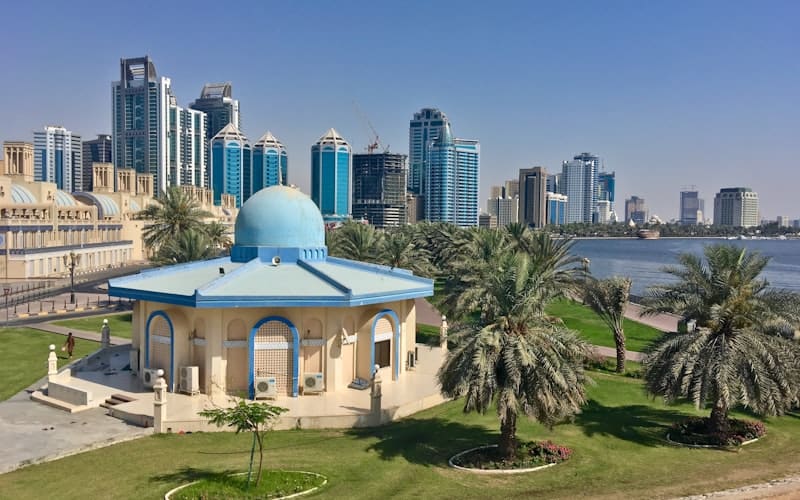
Al Majaz Waterfront
5/5Very SafeAl Majaz Waterfront guide: Sharjah's main evening promenade, with shisha lounges, cafés, and the Musical Fountain. No alcohol anywhere. What to expect, best venues, and practical tips.
6 nightlife spots listed
Al Qasba
5/5Very SafeAl Qasba guide: Sharjah's canal entertainment district with a Ferris wheel, international café chains, and family-oriented evening venues. No alcohol. Practical visitor guide.
5 nightlife spots listed
District Map of Sharjah
Pick a district to recenter the map and see hotels nearby.
Where to stay in Sharjah
Compare hotels and rentals across the city's nightlife districts.
See places to stay and current pricesLegal Framework
Sharjah operates under a more conservative legal framework than any other UAE emirate. Federal UAE law, including the prohibition on prostitution under Federal Law No. 3 of 1987, applies throughout the federation. Sharjah adds its own emirate-level Decency Law, enacted in 1996, which prohibits the sale, consumption, or possession of alcohol anywhere in the emirate with no exceptions.
No hotel in Sharjah holds an alcohol license. This is deliberate policy, not bureaucratic delay. The ruling Al Qasimi family has maintained the prohibition consistently for three decades, and there is no meaningful political pressure to change it.
Public behavior norms are codified and enforced. Mixed-gender socializing in public is subject to decorum rules. Unsupervised gatherings in parked cars can draw police attention. Unmarried couples sharing accommodation risk legal action if reported.
Enforcement Reality
Sharjah police actively enforce the decency rules. Hotel staff report violations. Complaints from residents are taken seriously and acted upon quickly. The emirate does not operate on the informal tolerance model that some parts of Dubai have developed.
Alcohol confiscation happens at highway checkpoints into Sharjah periodically, though not daily. Bringing duty-free alcohol purchased at Sharjah International Airport into the emirate for consumption here is prohibited, even in a private residence. The rule is not symbolic.
Digital communications are subject to the same monitoring that applies throughout the UAE. Explicit or solicitation-related messages can form the basis of a criminal charge. The practical risk is real, not theoretical.
That said, Sharjah's enforcement is aimed at protecting public decorum and keeping the emirate's conservative character intact. Tourists who act sensibly, dress appropriately, and avoid alcohol will find police encounters are essentially nonexistent.
Cultural Context
Sharjah is the UAE's culture capital in an official sense. The emirate hosts the Sharjah International Book Fair, one of the largest in the world, and has invested heavily in museums, art galleries, and public libraries. Its cultural infrastructure is far more developed than most Gulf cities of comparable size.
The emirate's population is roughly 85% expatriate, much like the rest of the UAE. A large South Asian workforce lives in industrial and residential areas inland. Arab professionals, educators, and government workers make up a significant slice of the population around the older city center.
Ramadan changes the rhythm of the city significantly. During the holy month, the evening hours see an intensified café and social culture: shisha lounges fill after iftar, and the waterfront promenades host families until 3 or 4 AM. Outside Ramadan, cafés and shisha spots typically run until 1 AM on weekdays and 2 AM on weekends.
One practical note: Sharjah's cost of living is lower than Dubai's, which is why a substantial portion of Dubai's workforce commutes from Sharjah. AED stretches further here. The absence of bar markups makes food and non-alcoholic drinks noticeably cheaper than equivalent venues across the border.
Dating Culture
Social life in Sharjah follows conservative norms more visibly than Dubai. Public displays of affection are inadvisable in any part of the UAE; in Sharjah, the social expectation is stricter and the chance of a complaint being filed is higher.
Expatriate workers in Sharjah socialize within professional and residential networks. Organized sports leagues, cultural events at the museums, and community gatherings at mosques serve as social infrastructure. The scene is quieter and more domestic than Dubai's.
Emirati nationals in Sharjah are more traditional in social behavior than their counterparts in Dubai. Interactions across unfamiliar gender and cultural lines are minimal in public spaces. This is not hostility; it's a different social framework that operates on community, family, and longer-term relationships rather than casual encounter.
The Social Scene
Sharjah's after-dark social life is built around two complementary things: coffee and shisha. Both are taken seriously here in a way that feels genuine rather than touristy.
Shisha quality at the waterfront lounges is genuinely good. Venues import tobacco from Jordan, Turkey, and Egypt, and a well-prepared pipe can last 45 minutes to an hour. Prices run AED 60-120 depending on the tobacco and venue, which is lower than equivalent shisha in Dubai. The waterfront setting at Al Majaz makes an evening over a shisha pipe an entirely reasonable night out.
Arabic coffee culture, meanwhile, is its own institution. Karak tea, a heavily spiced milk tea of South Asian origin that has become deeply embedded in Gulf daily life, is ubiquitous. The best karak in Sharjah runs AED 2-4 per cup. Fresh juice bars, mocktail menus, and specialty coffee roasters round out the options.
If you want alcohol, Dubai is close. The Sharjah-Dubai border is not a controlled crossing; it's a traffic intersection. By car, the nearest licensed venues in the Deira area of Dubai are 15-25 minutes away in off-peak traffic. By RTA bus, route E306 connects Sharjah's Al Jubail bus station to Dubai Union Metro station for AED 7.50.
Getting Around
- Bus: RTA operates routes between Sharjah and Dubai. The E306 runs from Al Jubail station to Dubai Union Metro. Journey time is 45-75 minutes depending on traffic
- Taxi: Licensed white Sharjah taxis are metered. Flag fall is AED 3. The ride-hailing app Careem operates in Sharjah
- Driving: Sharjah has widespread free parking in most residential and commercial areas. The main cost is the Sharjah-Dubai highway tolls and the notorious traffic on Sheikh Mohammed Bin Zayed Road
- Walking: Al Majaz Waterfront and Al Qasba are walkable within themselves. Getting between them requires a taxi or a 25-minute walk
Safety Considerations
Sharjah is one of the safest cities in the world. Personal crime is extremely rare. The risks for visitors are entirely legal and predictable:
- Do not bring alcohol into Sharjah, including from duty-free
- Do not appear intoxicated in public, whether you drank in Sharjah or in Dubai
- Dress code violations in public spaces carry fines. Cover shoulders and knees at all times outside private spaces
- Do not take photographs of people without consent, particularly women
- Public displays of affection can attract complaints and police involvement
- Zero blood alcohol tolerance applies to driving throughout the UAE
Save 999 (police) and your embassy's emergency number before going out.
Sources
- Sharjah Government Official Portal - Emirate-level regulations and public behavior guidelines
- U.S. Department of State: United Arab Emirates Travel Advisory - Entry requirements and local law summary
- UK Foreign, Commonwealth & Development Office: United Arab Emirates - Safety, health, and legal information for travelers
Get the Legal Status PDF, 50 countries
Newsletter signup coming soon. Check back shortly.
Flights to Sharjah
Compare prices across airlines. Filter by stops, time, and cabin.
Airport transfer to Sharjah
Pre-booked transfers cost about the same as a metered taxi but cut out the airport queue, the meter argument, and the "no English" routine that takes some drivers to the wrong address. Fixed price quoted before booking, driver tracks your flight, waits with a name sign at arrivals.
Book a KiwiTaxi transferFrequently Asked Questions
Related Guides
Al Majaz Waterfront
Al Majaz Waterfront guide: Sharjah's main evening promenade, with shisha lounges, cafés, and the Musical Fountain. No alcohol anywhere. What to expect, best venues, and practical tips.
Read guideAl Qasba
Al Qasba guide: Sharjah's canal entertainment district with a Ferris wheel, international café chains, and family-oriented evening venues. No alcohol. Practical visitor guide.
Read guideWas this guide helpful?